Other Projects
List of other projects carried out as part of this work by first-year MMI students.

A book aboutDNA with a special mention to Rosalind Franklin.
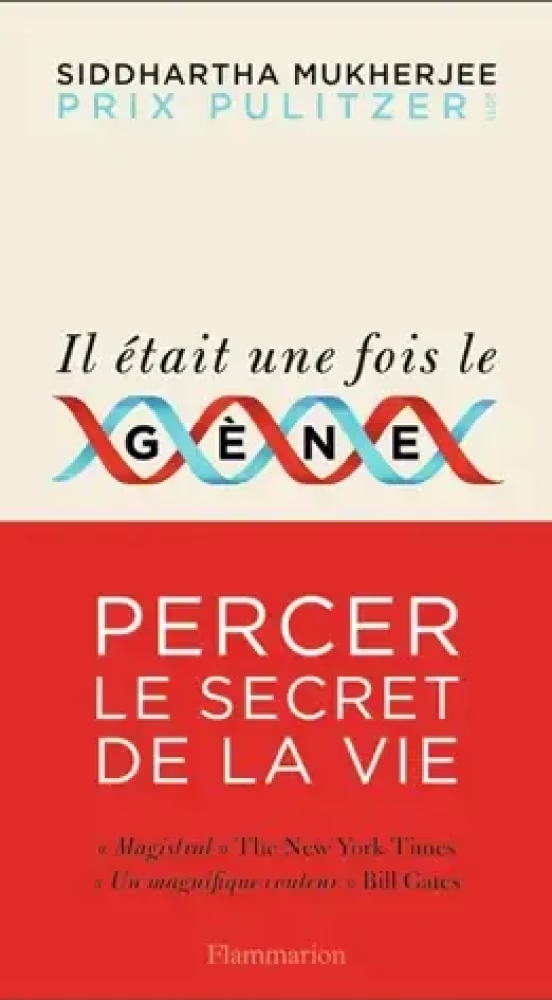
Between historical narrative and biology lecture, the author sets out to reveal the secrets of life and heredity, to explain genetics and its applications. He draws on his family history as well as numerous cases to shed light on what genes are and what they reveal about humans.
Aristotle and the Theory of Generation
Aristotle proposed an alternative theory that was truly revolutionary for his time. Perhaps females, like males, contribute to the material formation of the fetus through a kind of female semen. And perhaps the fetus develops with the mutual contribution of male and female parts.
Seeking analogies, Aristotle called the male contribution a “principle of movement.” The term “movement” here does not mean physical motion but rather instruction, or a kind of code in modern terms.
The matter actually transmitted during mating would, in fact, be only a facade for a more obscure and mysterious exchange. In reality, the matter itself would not be that important: what passes from man to woman is not matter, but a message.
Like the blueprint of a building guiding the workers, or the mind of a carpenter guiding his hand on a piece of wood, male semen would provide the instructions to construct a child.
"Nothing leaves the carpenter for the material that constitutes the pieces of wood [...] but it is the configuration and the form that come from him through the movement that is in the matter [...]," wrote Aristotle. "In the same way [...] nature, which is in the male, uses semen as a tool."
Female semen, on the other hand, would provide the raw material to form the fetus, like wood for the carpenter or mortar for the builder. It would be both the matter and the essence of life. Aristotle argued that the true material provided by the female is menstrual blood.
This blood would be shaped by the male semen to give the form of the child.
This may seem curious today, but here too Aristotle showed meticulous logic: since the disappearance of menstruation coincides with conception, he assumed that the fetus forms from it.
If Aristotle was mistaken about the distribution of male and female contributions into “matter” and “message,” he nonetheless grasped one of the essential truths about the nature of heredity. He conceived it, in modern terms, as the transmission of information.
This information is then used to build an organism from scratch, and the message becomes matter. When an organism reaches maturity, it produces semen in turn, transforming matter back into a message.
Thus, it was no longer the Pythagorean triangle, but a circle, a cycle where form gives information, and information gives form.
Centuries later, the biologist Max Delbrück would jokingly say that Aristotle should be awarded the Nobel Prize posthumously for the discovery of DNA.
List of other projects carried out as part of this work by first-year MMI students.